The single most effective time management tool I have ever utilized is a hand-written list. Any time I go for a period without working from to-do lists, I do notice a drop in efficiency and productivity. Far more gets accomplished with a list to guide me than without.
I do prefer the tactile feel of applying pen to paper. It's more carefully executed and more permanent than a list produced on a digital platform. There's just something about the act of writing that is more thoughtful and more deliberate.
Many recommend that one create lists on daily, weekly, and monthly levels, and some say annual and five-year lists should be considered. Although I do write down longer-range goals, I think that for now, I'm doing pretty well with just a weekly list to help guide me along. It allows me to focus on the week ahead, plan and prioritize, and make commitments on execution without feeling trapped by the restrictions of daily lists, or overwhelmed by a detailed monthly list. Flexibility is nice. If you've got a good head of steam and you're really sailing through projects, you can knock out even more on that week list than you originally intended for the day.
As your projects and priorities get accomplished, there are further benefits. The act of making check-marks and drawing lines through items is ridiculously satisfying. That satisfaction goads you on to complete more so that you can make even more check-marks and lines. At the end of the week, you may not realize how much you accomplished, but then you pick up that messy list and have a look - and with a sense of accomplishment you realize that yes - you actually did get a lot done!! That finished list is now also like a checkpoint on a map. It shows your progress on longer range projects so far, which will help you chart your course for the coming week.
I've put an awful lot on myself for upcoming projects, goals, and aspirations and even adventures in the next twelve months lying before me. With all that daunting stuff ahead, using lists has gone from handy to essential - or maybe even mandatory. It's the only way I can keep everything straight. Without goals you don't have a destination - but if you have a goal and are without planning and lists, you have a destination without a map or compass, or a solid idea of how to get to there from here!
Well, back to my own list for the week ahead - let's see how much of that I can get accomplished!
Search This Blog
Showing posts with label art business. Show all posts
Tuesday, September 09, 2014
Wednesday, June 29, 2011
I Love Teaching!
Over the last several years as I demonstrate the process of feather-painting from my booth at shows, I have encountered more and more folks who express an active interest in wanting to learn and try this unique art for themselves. While I had taught kids through the Scouting program, I admittedly felt a little nervous about teaching adults. Anything unfamiliar makes us a little nervous.
Last Summer I taught feather-painting to a great group of kids at the Fred Oldfield Western Heritage Center. During this instruction, several of the adult teachers and volunteers also jumped in to learn the art. We all had great fun! I'm oh so looking forward to teaching this again at this year's American Indian Day Camp at the Center.
This Spring I decided to teach workshops in feather-painting at Lucas Art Gallery in Graham. Still a little uncomfortable about it, but determined to do it as so many have been wanting to learn. The experience was fantastic! The class was completely full. We painted wolves in a night scene with birch trees and snow, and everyone left happily carrying their completed feathers.
Our next workshop went just as well - we worked on Goldfinches and Thistles. This coming Saturday's workshop will be eagles. We still have a few openings, if you'd like to come join the fun! Call Karen Lucas at Lucas Art Gallery in Graham WA at 253-847-0858
Soon, I hope to be taking these workshops on the road. I've begun making queries down in Centralia Washington, as there are quite a few down there who would like to learn. Where next? Time will tell... but I'm looking forward to the trip!
Last Summer I taught feather-painting to a great group of kids at the Fred Oldfield Western Heritage Center. During this instruction, several of the adult teachers and volunteers also jumped in to learn the art. We all had great fun! I'm oh so looking forward to teaching this again at this year's American Indian Day Camp at the Center.
This Spring I decided to teach workshops in feather-painting at Lucas Art Gallery in Graham. Still a little uncomfortable about it, but determined to do it as so many have been wanting to learn. The experience was fantastic! The class was completely full. We painted wolves in a night scene with birch trees and snow, and everyone left happily carrying their completed feathers.
Our next workshop went just as well - we worked on Goldfinches and Thistles. This coming Saturday's workshop will be eagles. We still have a few openings, if you'd like to come join the fun! Call Karen Lucas at Lucas Art Gallery in Graham WA at 253-847-0858
Soon, I hope to be taking these workshops on the road. I've begun making queries down in Centralia Washington, as there are quite a few down there who would like to learn. Where next? Time will tell... but I'm looking forward to the trip!
Saturday, January 29, 2011
What got you started?
When did you decide to 'go big' and really seek to make a go of art as a career? Who inspired you? Were you striving to drop the day job and throw everything you had into your art?
This hit me recently as I was rummaging through old binders in the studio. I came across one dusty old green binder that I had not opened in quite a long time... several years, in fact. It's interesting to say the least when you discover a time capsule of sorts from when you first got really serious about growing your art and taking it beyond "enjoyable sideline" and making it your career.
The bulk of these documents, all neatly categorized with dividers, wore the date of June, 2002. This truly was when I was really seeking to grow and expand. There wasn't a whole lot on the internet for art business then. I'm not positive but I don't think that even Alyson Stanfield had her weekly art biz newsletters then. At least, I hadn't found her yet. I was a subscriber of Robert Genn and his twice-weekly emails, but beyond that I spent hours and hours searching and compiling and making lists from the internet.
Most of the material in my trusty old research binder was written by Geoffrey Gorman. He had produced articles under Art Matters and a really nice art business development packet under Tailwind. Sadly, I cannot find any of this online now. Thank goodness I printed out hard copies of all that and put it in a binder! Note to self (and all of you!) Never trust that the good and useful information you find online will remain where it is. If it's that useful to you, save it!
For someone who was just starting out, and more than a bit fearful, this stuff was a goldmine. Although I was showing in galleries and gift shops, and had been for 12 years at that point, I knew I wanted to do more. By running Google searches for art shows in Western Washington, I soon found that we had a wealth of such opportunities in this region. It wasn't long before I had a good-sized list of potential shows to try and enter. What I still lacked at that point was courage. It was easy to see that lack of knowledge was the cause of that and I began seeking the what and the how. Geoff Gorman provided many detailed answers to this beginner's questions, as did Alyson Stanfield when I found her valuable information online, and soon I was attempting the local shows. It was terrifying to make that plunge, but the rewards were big. I won some ribbons, I made some sales. And I gained confidence.
As I tried more and more shows, soon trying larger ones that I never dreamed I would be able to participate in, I continued to seek more and more information online. That art biz information was increasing in availability, as it still is. I knew I had to build a better online presence and left Geocities for better options. I got busy participating in lots of online art forums. It soon became apparent that the more places one could be seen online, the better. And if you're doing more than merely showing your work but actually participating, all the better.
It's been a long and continual learning experience, and I am still learning... at times learning as fast as I can. I'm going to go back through that binder more slowly and see what's changed and what still applies. There's not much call anymore for slide submissions for shows, but I do have that info in the binder. One bit that was very interesting to revisit was the section in Tailwind that asks ""Where Do You Want To Be In Five Years"? Now THAT was interesting, especially considering how much of that had actually been achieved in five years' time! I wanted to be in print, to drop the day job, to be selling in shows and galleries, to have a nice studio, to be well known for my work...
You hear stories of this happening when someone gets very specific about goals and intentions, but it really is something to see for yourself that it really does work! It may well be time to draft another five year plan. ;-)
Happy Weekend! :-)
This hit me recently as I was rummaging through old binders in the studio. I came across one dusty old green binder that I had not opened in quite a long time... several years, in fact. It's interesting to say the least when you discover a time capsule of sorts from when you first got really serious about growing your art and taking it beyond "enjoyable sideline" and making it your career.
The bulk of these documents, all neatly categorized with dividers, wore the date of June, 2002. This truly was when I was really seeking to grow and expand. There wasn't a whole lot on the internet for art business then. I'm not positive but I don't think that even Alyson Stanfield had her weekly art biz newsletters then. At least, I hadn't found her yet. I was a subscriber of Robert Genn and his twice-weekly emails, but beyond that I spent hours and hours searching and compiling and making lists from the internet.
Most of the material in my trusty old research binder was written by Geoffrey Gorman. He had produced articles under Art Matters and a really nice art business development packet under Tailwind. Sadly, I cannot find any of this online now. Thank goodness I printed out hard copies of all that and put it in a binder! Note to self (and all of you!) Never trust that the good and useful information you find online will remain where it is. If it's that useful to you, save it!
For someone who was just starting out, and more than a bit fearful, this stuff was a goldmine. Although I was showing in galleries and gift shops, and had been for 12 years at that point, I knew I wanted to do more. By running Google searches for art shows in Western Washington, I soon found that we had a wealth of such opportunities in this region. It wasn't long before I had a good-sized list of potential shows to try and enter. What I still lacked at that point was courage. It was easy to see that lack of knowledge was the cause of that and I began seeking the what and the how. Geoff Gorman provided many detailed answers to this beginner's questions, as did Alyson Stanfield when I found her valuable information online, and soon I was attempting the local shows. It was terrifying to make that plunge, but the rewards were big. I won some ribbons, I made some sales. And I gained confidence.
As I tried more and more shows, soon trying larger ones that I never dreamed I would be able to participate in, I continued to seek more and more information online. That art biz information was increasing in availability, as it still is. I knew I had to build a better online presence and left Geocities for better options. I got busy participating in lots of online art forums. It soon became apparent that the more places one could be seen online, the better. And if you're doing more than merely showing your work but actually participating, all the better.
It's been a long and continual learning experience, and I am still learning... at times learning as fast as I can. I'm going to go back through that binder more slowly and see what's changed and what still applies. There's not much call anymore for slide submissions for shows, but I do have that info in the binder. One bit that was very interesting to revisit was the section in Tailwind that asks ""Where Do You Want To Be In Five Years"? Now THAT was interesting, especially considering how much of that had actually been achieved in five years' time! I wanted to be in print, to drop the day job, to be selling in shows and galleries, to have a nice studio, to be well known for my work...
You hear stories of this happening when someone gets very specific about goals and intentions, but it really is something to see for yourself that it really does work! It may well be time to draft another five year plan. ;-)
Happy Weekend! :-)
Monday, April 26, 2010
Blogging for Artists - introduction, and some benefits
I am back up and running on a new computer. Unfortunately I do not have certain programs installed on this new machine yet, like Photoshop. Rather than wait to update any longer because I haven't yet got the ability to make that hiking post about the Trotternish like I said (it would be image heavy), I hope you don't mind my providing something else.
I was asked to do a presentation to a local artist group about social marketing, so I'm starting off with blogging for artists.
An online presence of some form is essential for success in today's art market. An online location such as a website becomes your storefront. Unlike your studio or your representing gallery, your website is available for perusal 24/7. And unlike those physical venues, there are almost no geographic restrictions. you really can bring your art to the world.
Website: Your website is your anchor. it is the fulcrum from which all your online marketing extends. The website has long since become the accepted business standard, but it does have its drawbacks.
-Cost. Hiring a professional can be expensive, as can purchasing some of the website building programs that are available.
-Time. if you build it yourself, it is very time-costly - especially if it involves coding. There is also the matter of a professional's time, as your site is likely not the only site he has to keep updated. Those updates may not come as quickly as you would prefer.
-Updates. When your website is updated, who's going to know? You have an email list, and you may notify your friends and patrons this way, but that too takes time. there is no automatic notification that I am aware of for websites.
A website tends to be static and seldom changes. It best serves you as your base online portfolio in which you showcase your best work and provide your essential information such as artist bio, contact information, and calendar of shows and events. Do update it, quarterly at the very least.
Blog: Your blog, unlike your website which changes very little, is organic and constantly growing. Your website is a showcase of your best art, but your blog may show the working process of new pieces. it may also be a place for your readers to come and get to know you a little bit better. A blog also encourages community and interactivity, it is more social.
Consider your favorite blogs - what attracted you to them? What keeps you coming back? A good blog that attracts frequent visitors is one that has good content, good imagery, and is updated regularly. A successful blog provides value - whether it informs, inspires, or simply entertains, that blog provides something useful and of value for the reader to take away. readers come to fulfill a need.
Benefits of Blogging: Blogs have many benefits over websites. Community, ease of use, cost-friendly (most are free!), and instant publishing are a few.
-RSS. Blogs may also be subscribed to by RSS, or Real Simple Syndication. This allows the readers to see immediately what new articles you've written without actually going to the blog. They are immediately notified of updates without any email notifications or other work on your part.
-Community. You may allow comments to your blog, which lends a level of interactivity that your website just doesn't have. In some blog platforms, such as Blogger, you may 'follow' other blogs within that platform. You may also add a list of your favorite blogs in a 'blogroll' and others will add you to theirs. through these activities you may build a network. You may ask questions on other blogs and answer questions and comments on your own. you're building a connection with people. As your community grows, so do friendships. You'll begin to see people frequenting blogs not only for the content, but also for the conversation. this is the 'social' in social networking and it is a very powerful tool.
-Search Engines. It is a fact that search engines love blogs. Search engines search for words, and blogs are just full of them. Search engines also like freshly-updated URL's and blogs definitely provide that, much more so than websites do. Keeping that in mind, when you make a blog post, whenever possible (and without being obnoxious about it) include key words that people would use in searching for you or your work. You may have noticed I use the words 'painted feathers' in many of my blog posts, and that is to help people find me. Keep in mind the words people might search in finding you or work similar to what you do, and employ them when you can.
Cost. I have already touched on this one, but it's worth saying again. Most blogs are free. Websites can often be costly, both monetarily and in time, and a blog is thrifty in both.
Ease of use. You can literally set up your brand new blog in a matter of minutes. You don't need to know codes, you simply choose a style you like, write your article, add your images (which is also very easy), Title it, add some tags if you choose, click 'publish', and voila, your article has been published to the internet and within minutes it's already available to your subscribers' RSS feeds. What could be easier?
How often should you update? It needs to be at whatever rate you are comfortable with. If just once a week is all you can handle, that is fine - but an effective blog needs to be updated at least once a week and preferably more frequently than that if you can manage it. If you can't do that right away, work up to it. I made a goal this year to get much better at blogging, and just when I had a good rhythm going my computers melt down. Stuff happens! Recover your footing, and drive on when you can.
What should you write about? Write about anything you like, anything you have a passion for. Be personable, and above all be genuine. If you're not comfortable or knowledgeable in the subject you're writing about, it will show! Your readers will see it. It won't feel natural to you and it won't come off as authentic to those reading. Just be yourself. As an artist, you have a plethora of blogworthy material. What is your latest project? Show us, tell us about it, blog about some of your process. did you go some place special to gain the experiences and reference material? We'd love to hear about it. Have you got some big goals, upcoming shows? how about hobbies that you love that don't even involve art? it's all good. Consider those blogs you like to read... they probably involve a lot of your own interests, right? That's who you're writing for, yourself and for those people who share your interests as well as those people who follow your art. You could even gain new followers of your art simply by writing about your interests.
If you don't have a website, a blog is a very good alternative. If you do have a website, however, a blog should not replace it, it should simply compliment it. Link to your blog on all your major website pages. Show your latest artworks on your blog. Announce website revisions on your blog. Your blog has great potential to drive traffic to your website, and vise-versa. Use them both, update your blog regularly and see how much your website visits climb.
~Happy blogging!
I was asked to do a presentation to a local artist group about social marketing, so I'm starting off with blogging for artists.
recent commissioned painting of wolves, acrylics on peacock feather
An online presence of some form is essential for success in today's art market. An online location such as a website becomes your storefront. Unlike your studio or your representing gallery, your website is available for perusal 24/7. And unlike those physical venues, there are almost no geographic restrictions. you really can bring your art to the world.
Website: Your website is your anchor. it is the fulcrum from which all your online marketing extends. The website has long since become the accepted business standard, but it does have its drawbacks.
-Cost. Hiring a professional can be expensive, as can purchasing some of the website building programs that are available.
-Time. if you build it yourself, it is very time-costly - especially if it involves coding. There is also the matter of a professional's time, as your site is likely not the only site he has to keep updated. Those updates may not come as quickly as you would prefer.
-Updates. When your website is updated, who's going to know? You have an email list, and you may notify your friends and patrons this way, but that too takes time. there is no automatic notification that I am aware of for websites.
A website tends to be static and seldom changes. It best serves you as your base online portfolio in which you showcase your best work and provide your essential information such as artist bio, contact information, and calendar of shows and events. Do update it, quarterly at the very least.
Blog: Your blog, unlike your website which changes very little, is organic and constantly growing. Your website is a showcase of your best art, but your blog may show the working process of new pieces. it may also be a place for your readers to come and get to know you a little bit better. A blog also encourages community and interactivity, it is more social.
Consider your favorite blogs - what attracted you to them? What keeps you coming back? A good blog that attracts frequent visitors is one that has good content, good imagery, and is updated regularly. A successful blog provides value - whether it informs, inspires, or simply entertains, that blog provides something useful and of value for the reader to take away. readers come to fulfill a need.
Benefits of Blogging: Blogs have many benefits over websites. Community, ease of use, cost-friendly (most are free!), and instant publishing are a few.
-RSS. Blogs may also be subscribed to by RSS, or Real Simple Syndication. This allows the readers to see immediately what new articles you've written without actually going to the blog. They are immediately notified of updates without any email notifications or other work on your part.
-Community. You may allow comments to your blog, which lends a level of interactivity that your website just doesn't have. In some blog platforms, such as Blogger, you may 'follow' other blogs within that platform. You may also add a list of your favorite blogs in a 'blogroll' and others will add you to theirs. through these activities you may build a network. You may ask questions on other blogs and answer questions and comments on your own. you're building a connection with people. As your community grows, so do friendships. You'll begin to see people frequenting blogs not only for the content, but also for the conversation. this is the 'social' in social networking and it is a very powerful tool.
-Search Engines. It is a fact that search engines love blogs. Search engines search for words, and blogs are just full of them. Search engines also like freshly-updated URL's and blogs definitely provide that, much more so than websites do. Keeping that in mind, when you make a blog post, whenever possible (and without being obnoxious about it) include key words that people would use in searching for you or your work. You may have noticed I use the words 'painted feathers' in many of my blog posts, and that is to help people find me. Keep in mind the words people might search in finding you or work similar to what you do, and employ them when you can.
Cost. I have already touched on this one, but it's worth saying again. Most blogs are free. Websites can often be costly, both monetarily and in time, and a blog is thrifty in both.
Ease of use. You can literally set up your brand new blog in a matter of minutes. You don't need to know codes, you simply choose a style you like, write your article, add your images (which is also very easy), Title it, add some tags if you choose, click 'publish', and voila, your article has been published to the internet and within minutes it's already available to your subscribers' RSS feeds. What could be easier?
How often should you update? It needs to be at whatever rate you are comfortable with. If just once a week is all you can handle, that is fine - but an effective blog needs to be updated at least once a week and preferably more frequently than that if you can manage it. If you can't do that right away, work up to it. I made a goal this year to get much better at blogging, and just when I had a good rhythm going my computers melt down. Stuff happens! Recover your footing, and drive on when you can.
What should you write about? Write about anything you like, anything you have a passion for. Be personable, and above all be genuine. If you're not comfortable or knowledgeable in the subject you're writing about, it will show! Your readers will see it. It won't feel natural to you and it won't come off as authentic to those reading. Just be yourself. As an artist, you have a plethora of blogworthy material. What is your latest project? Show us, tell us about it, blog about some of your process. did you go some place special to gain the experiences and reference material? We'd love to hear about it. Have you got some big goals, upcoming shows? how about hobbies that you love that don't even involve art? it's all good. Consider those blogs you like to read... they probably involve a lot of your own interests, right? That's who you're writing for, yourself and for those people who share your interests as well as those people who follow your art. You could even gain new followers of your art simply by writing about your interests.
If you don't have a website, a blog is a very good alternative. If you do have a website, however, a blog should not replace it, it should simply compliment it. Link to your blog on all your major website pages. Show your latest artworks on your blog. Announce website revisions on your blog. Your blog has great potential to drive traffic to your website, and vise-versa. Use them both, update your blog regularly and see how much your website visits climb.
~Happy blogging!
Thursday, March 04, 2010
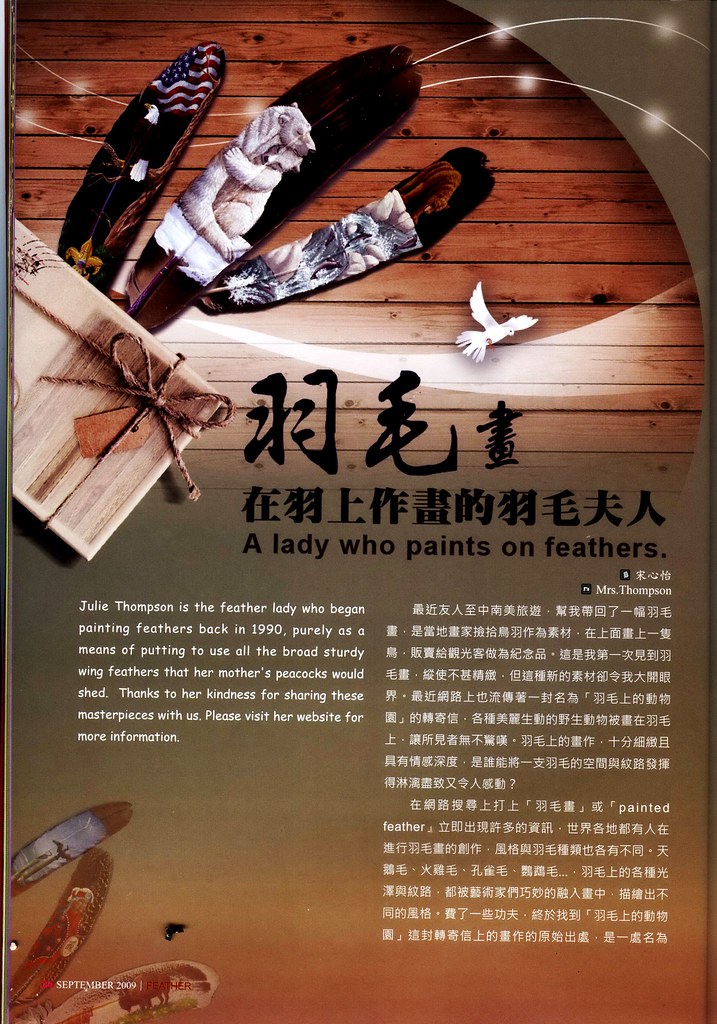
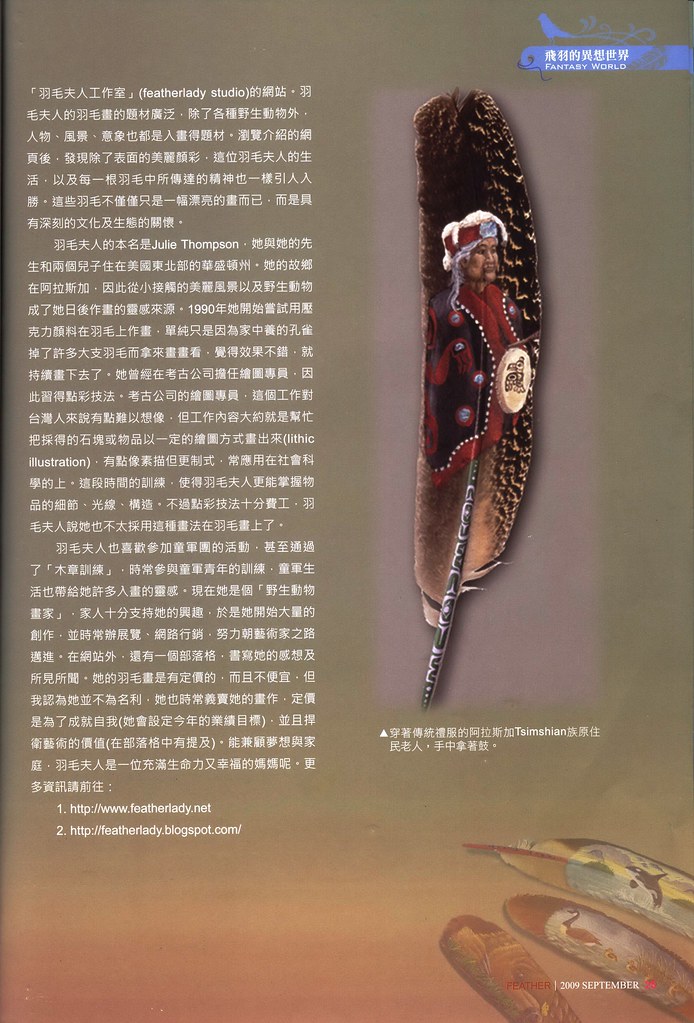
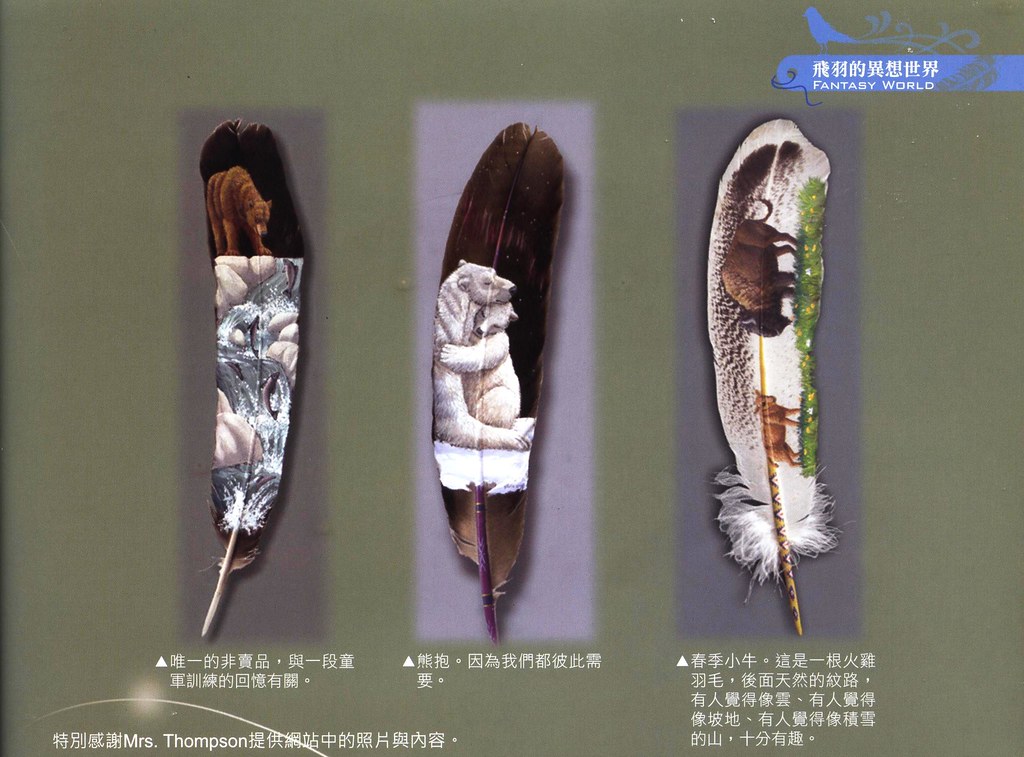
Painted Feathers Article in China
An email came in from the publisher the other day. She had first contacted me last Autumn, requesting permission to publish my story and artwork, which I accepted.
Her recent note included these images of the article from last September. She mentioned she had meant to send them on much sooner, but business being busy, had thought she had already done it.
I'm looking forward to having a hard copy of Chinese Wild Bird Magazine here in the studio. Don't you just love the fun layout they did with the article?
Her recent note included these images of the article from last September. She mentioned she had meant to send them on much sooner, but business being busy, had thought she had already done it.
I'm looking forward to having a hard copy of Chinese Wild Bird Magazine here in the studio. Don't you just love the fun layout they did with the article?
Tuesday, January 19, 2010
Clarity through Seven Words
Slowly but surely I'm getting things migrated over to the laptop. My husband's got my email set up here, but it appears that the old desktop computer has swallowed some of those pertinent emails. Please be patient with me as I get things fully integrated with the new system. and find these bits that are currently MIA.
Recently Todd Henry on Accidental Creative issued a challenge: create a seven word bio. How can you condense what you do down to its bare essence in seven words? It's absolutely brilliant, because 1) it forces you to cut the clutter and focus on the simple basics of what your art, your business, what have you is all about. 2) By trying to concentrate this concept into the confines of 7 words, you try to explain it with great clarity, yet with enough creative punch to compel your reader to want to learn more. It's not an easy task! His is outstanding, by the way: The arms dealer for the creative revolution. Mine is a work in progress, I'm not yet satisfied with it: Detailed wildlife paintings on naturally shed feathers. I've also considered Portraits of nature on nature's own canvas. See? It's not so easy!
Have you ideas of a seven word bio for yourself? Please do share it here in comments. You'll be surprised how it will inspire you to employ it, or at least its influence, elsewhere. This little challenge has already compelled me to cut all the clutter on the 'about me' portion here on the blog and pare it down to its current simplicity... but that, too, is a work in progress. :-)
Recently Todd Henry on Accidental Creative issued a challenge: create a seven word bio. How can you condense what you do down to its bare essence in seven words? It's absolutely brilliant, because 1) it forces you to cut the clutter and focus on the simple basics of what your art, your business, what have you is all about. 2) By trying to concentrate this concept into the confines of 7 words, you try to explain it with great clarity, yet with enough creative punch to compel your reader to want to learn more. It's not an easy task! His is outstanding, by the way: The arms dealer for the creative revolution. Mine is a work in progress, I'm not yet satisfied with it: Detailed wildlife paintings on naturally shed feathers. I've also considered Portraits of nature on nature's own canvas. See? It's not so easy!
Have you ideas of a seven word bio for yourself? Please do share it here in comments. You'll be surprised how it will inspire you to employ it, or at least its influence, elsewhere. This little challenge has already compelled me to cut all the clutter on the 'about me' portion here on the blog and pare it down to its current simplicity... but that, too, is a work in progress. :-)
Thursday, January 15, 2009
Bracing for Growth

A friend does readings that I have found to be incredibly spot-on. Occasionally she generously offers a free one-card-draw with these Balance cards that she created. The card that
This was her interpretation:
Wow, I almost feel sorry for you, because I drew the Sapling and that shows up at the beginning of big and lasting things, indicating that they're about to grow.
I don't know if you can handle much more growth at the rate your growth is growing!
So... um... I will look at this and say, "Please schedule in some rest time for yourself, or you will collapse in the orchard." :)
Being that business and professional pursuits were very much on my mind when I asked for a card, I can't imagine what else it would be, other than business and profession. Though I was hoping for a card that indicated travel and adventure! ;D
The best ways I can think of to be ready for further growth is improving one's workplace and streamlining how things get done.
I think that proper insulation of the studio definitely HAS to be on the must-do list sometime this year. The room is too frigid in winter to work in there, and too expensive to heat. The most I can do in there these days is stain mouldings and join frames. And that's a shame! It's a nice-sized room! Yes, must put some attention to this workspace and make it a better, more comfortable working environment.
With so many eagles and flags being requested, for veterans and for Scouts, I've gotten into the routine of having the mats, glass, and frames all ready to go - several of them - at any given time. It just makes production so much easier, because the formula for those never varies. Red and blue mats, with muted blue mat for the background; bullnose moulding, dark walnut stain. Keep it simple and straightforward, and the work-time will improve. Can't do that with everything else though, because the colours, themes, subject matter, and individual tastes are so varied! There's no buttonholing anything else. But at least with the single most popular, it's a set standard.
I haven't done it yet, but I do plan on charting incoming commissions- orientation, subject matter, customer's stats, need-by date, etc. It will be a tactile thing, hand-done on large paper and tacked to the studio wall. This is to hopefully help streamline things, but even more so to make sure that no one is missed. I'm very much a visual thinker, and if it's all drawn out and in front of me, I can more easily follow.
Email. I must apologize if I have not yet responded to your email! the holidays were overwhelming and I'm still trying to catch up. During all of last year my inbox was admittedly in a constant state of overwhelm- there were so many queries coming in as a result of that wandering painted-feathers email that I just could not get on top of it all and paint too. I'm tackling that problem.
I have divided up business emails in my inbox. I flag any email pertaining to business, from clear queries right on down to a simple friendly "hey, I like your work". All those little red flags greet me and tell me "HEY, you need to get on these!" When I respond to them, I move them to the "answered queries" folder. if I hear back from a person and it turns out that they would like to order, then that email and anything else they sent goes to the "active orders" folder. This way I can follow the conversation and keep up on the little details that they want to include in their commissioned piece.
Admittedly, it's bit cumbersome, but it's a start in organization. :)
Have you come upon any methods and techniques in dealing with business email that you've found extremely useful? If so, I'm all ears! ;D
Subscribe to:
Comments (Atom)